William Oh–Loth partnership
The Legend of William OhThe William Oh–Loth partnership is one of the most consequential alliances in William Oh’s early life as a Climber: it joins a one-handed human who combines climbing with magic to a kobold whose intelligence, tools, and insects transform the environment into a usable system of routes, alarms, ropes, and weapons. Their partnership is founded not on shared species or background but on reciprocal recognition. William Oh accepts what Loth offers, while Loth recognizes that the human’s reputation, nerve, and physical ability can make their combined strengths unusually effective.
Formation Through Mutual Recognition
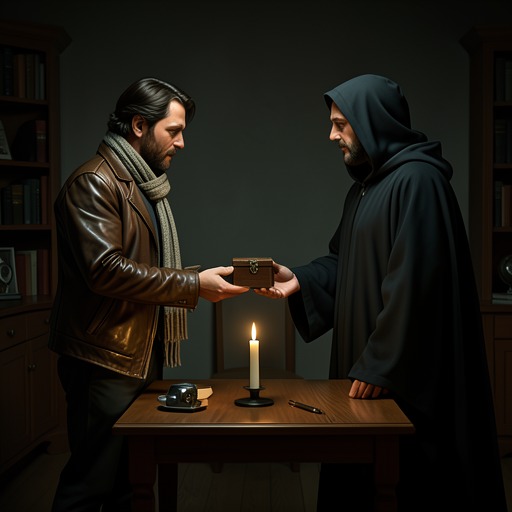
Loth first approaches William Oh when the other young Climbers have separated into competing groups. He offers William a wriggling grub, and William accepts and eats it rather than rejecting either the food or the kobold’s gesture. The act is practical—free food is not to be refused—but it also becomes the partnership’s first test. Loth identifies it as an acceptance of friendship and explains that human custom calls for clasping hands. William responds by shaking Loth’s oddly pebbled hand and giving his name as William Oh.
Loth immediately treats the introduction as an omen of success, declaring that their victory is assured. The confidence is partly comic and partly strategic: by naming William’s presence as an advantage, Loth frames the alliance as more than accidental companionship. William, meanwhile, is startled when the surrounding teenagers recognize him as the William Oh whose name has already acquired public force. The partnership therefore begins at the intersection of personal contact and reputation. Loth sees the person standing before him, but he also understands the value of the name.
William’s decision to accept Loth is significant because it contrasts with the social clustering around them. The other young men and women quickly form groups, leaving William effectively alone except for the kobold. Loth’s offer gives William both immediate company and a collaborator willing to work with him without requiring him to conform to an established human team. The relationship grows from a small exchange, but the exchange establishes its governing principle: usefulness and trust can cross boundaries that ordinary group identity keeps rigid.
Complementary Skills in the Caves
When the pair scouts the branching caves in search of the kaith supply line, their differences become operational strengths. William can move through difficult vertical spaces and is willing to investigate hazards that the others might avoid. Loth supplies the method that lets such movement become survivable. His barrel of soil and food scraps houses dozens of insect species, all of which he controls with ease. The barrel is not merely luggage; it is a portable reserve of specialized capabilities.
Loth’s insects also solve the problem of navigation. Because the tunnels branch and plunge into darkness, the two can easily lose their route or become vulnerable to an attack from behind. Loth marks each branch with arrows made from the luminescent juices of crushed glowbugs. The marks turn an unstructured cave system into a mapped path that the pair can retrace. His knowledge of small creatures consequently produces a large tactical advantage: the partnership does not depend on memory alone, and retreat remains possible even in the blackness.
William’s preferred solution to the danger is direct and physical. When they find a hole in the floor, he argues that it should be explored rather than left as an avenue for an ambush. He chooses to descend because he is better suited to climbing than the other members of the expedition. This decision reveals the division of labor between them. William takes responsibility for the exposed movement, while Loth prepares the conditions that make the movement intelligible and recoverable.
Loth’s silk-striders extend that preparation. The domesticated spiders are poor hunters but can produce several kinds of silk on command. Loth uses them to string an almost invisible strand across the far tunnel, then hangs a tiny bell from it. By plucking the silk, he tests the alarm and completes the trap in roughly five seconds. The device is nearly invisible, but its purpose is unmistakable: Loth converts the cave’s concealment into early warning. William’s climbing route is thus protected by a network of small, carefully placed interventions that only Loth knows how to make.
The danger of the descent proves that the arrangement is necessary. William ends up hanging by one hand in complete darkness above an unknowable drop, potentially near a hive of flesh-eating creatures. After securing his weapon, he still has no foothold and realizes that he may be suspended from the ceiling of a thousand-foot drop. Loth does not abandon him or treat the predicament as proof that William’s judgment was worthless. He rappels down on spider-silk rope, calls to establish whether William is alive, and brings the equipment needed to bridge the gap.
When William reaches a ledge, Loth throws him a rope and directs him to hold it against the wall. Loth then slides down the tightened line and lands beside him, carrying a metal hook with a spring-loaded latch. His assistance is concrete rather than sentimental, but it expresses the partnership more clearly than reassurance would. William accepts the dangerous route because of his climbing ability; Loth follows with tools that make rescue and continued movement possible.
Combat, Magic, and Tactical Trust
The partnership also depends on William’s ability to shift from physical climbing to combat and magic. Loth observes that William is remarkably good at climbing despite being a one-handed human. William explains that half of his Class is devoted to climbing and reveals that the other half is devoted to magic by releasing the Sting Ring from Dimensional Storage into his palm. Loth’s reaction is interest rather than suspicion. The exchange clarifies that each partner is still learning the full extent of the other’s capabilities, but neither treats unfamiliarity as a reason to withdraw.
Their cooperation becomes especially visible when they encounter a hostile Nuker who intends to expose William as a fraud. William interrupts the speech to tell Loth that the route is clear. Loth answers from beneath the ledge and then climbs up through the space below them. He pulls taut silk from the floor and cuts it with a belt knife, releasing a massive store of energy that snaps into the darkness. The maneuver demonstrates that Loth’s traps are not merely alarms: they can also become forceful tactical devices capable of altering the immediate battlefield.
William’s response to Loth’s methods is teasing rather than fearful. After Loth avoids answering whether he is unusual for a kobold, William calls him a trap-laying son of a bitch and recognizes that the question itself is a trap. Loth identifies the remark as the closest thing to a compliment his species has received from William. Their humor is part of their working rhythm. It allows them to acknowledge danger and difference without turning every unfamiliar trait into a conflict.
The pair’s cooperation continues even when William takes the lead. He repeatedly makes the decisive physical choice—descending, climbing, or moving ahead—while Loth supports the choice with equipment, warning systems, and improvisation. Neither role is passive. William’s initiative would be reckless without Loth’s preparations, while Loth’s devices would have less reach without a partner willing to enter the places they make accessible. Their effectiveness comes from the rapid exchange between bold action and technical correction.
Reputation, Separation, and the Meaning of Partnership
William’s public reputation gives the partnership an unusual social dimension. Jason Salazar promotes stories about William, including the claim that William was born on the Hundredth Floor and bathed in lethal Miasma. Later, a clerk identifies William as the correct one among six people using the same name and reports that the System has rated his performance as exceptional. The existence of imitators shows that William’s name has become valuable enough to borrow, while the reward confirms that his actual performance can sustain at least part of the legend.
The stories grow more extravagant as they spread. In an inn, strangers claim that William Oh can turn into lightning, that his severed hand became a cursed talisman, and that he once ate a lightning bolt fired into his face by a Nuker. These accounts are not reliable descriptions of William, but they affect the conditions in which he and Loth operate. William is no longer merely a person seeking companions; he is a mobile reputation that attracts attention, suspicion, and expectations. Loth’s partnership offers a counterweight to that public fiction because it is based on repeated observation of what William actually does under pressure.
The relationship also exists within the harsh economics of climbing. William estimates only a twenty-percent chance that Jason Salazar will spend money on becoming stronger, but he regards even that chance as a possible source of a reliable team member. Later, William and Loth must acclimate for a day before attempting the Third Floor, and they choose to gain levels rather than follow a bus immediately. The fastest route upward is to run behind a bus and help clear the Key Site, provided a Climber does not sabotage the others, but Loth points out that entering a higher Floor below the current Floor’s maximum level would be foolish. His judgment restrains William’s impatience and protects the partnership from turning ambition into premature exposure.
William’s trust is not blind. In the caves, after he has made a conspicuous decision, he sits against the cold stone and repeatedly asks why he did it. Loth sits beside him and explains William’s stated reason: he had not wanted the other Climbers to become accustomed to his greatness and then suffer in its absence. The exchange reveals a relationship capable of absorbing embarrassment and self-doubt. Loth does not flatter William into confidence, nor does he exploit the moment to diminish him. He answers with the same dry steadiness that characterizes his technical support.
Development and Narrative Significance
The partnership’s decisive feature is its movement from gift to system. Loth’s grub begins the relationship as an offered sign of friendship. His insects, glowbug markings, silk-strider ropes, alarm bell, hooks, and traps then turn that friendship into a repeatable survival practice. William contributes the willingness to accept the gift, the strength to act on difficult terrain, and the combat and magical capacity to make use of the openings Loth creates. Each later scene confirms that the first handshake was not an isolated gesture but the beginning of a functional interdependence.
Their bond also complicates the social boundaries of the Tower. William is a human known for an increasingly distorted legend; Loth is a kobold whose intelligence and technical competence challenge human assumptions about what a kobold is supposed to be. William’s teasing recognition that Loth is a trap-layer, and Loth’s identification of that insult as a compliment, allow the partnership to acknowledge difference without erasing it. They do not become alike. They become more capable precisely because their abilities remain distinct.
By the time they leave the scouted area together, William tells June and Reggie that they will head out and that the others may follow when ready, then joins Loth in walking back into the darkness. The brief departure captures the relationship’s settled form: Loth is no longer an unexpected companion encountered at the edge of a crowd, but William’s chosen partner in an unexplored environment. Their alliance gives William a reliable teammate, gives Loth a human willing to recognize his value, and gives the narrative a durable model of cooperation in which survival depends as much on trust, preparation, and complementary intelligence as on raw power.